Are you hiring good judgment—or a good interview?
How Dutch startups can run fair, useful interviews with US candidates without copying big-tech loops or mistaking polish for fit.
Updated
A candidate can finish a long interview process knowing more about its puzzles than about the work waiting at the company. The hiring team can be left in a similar position: plenty of scores, less certainty about how it would feel to solve a real problem together.
When I think about interviewing for a Dutch startup, I want the process to bring both people closer to that understanding. A candidate relocating from the US is considering a substantial change. Give them a fair chance to show their judgment and enough of the company’s real work to decide whether they want to join it.
Design for the job you actually run
Write down the decisions, collaborators, and constraints of the role. Then choose two or three interview formats that touch those realities. A system conversation about your architecture, a walkthrough of a past incident, a hiring or prioritization exercise, or a short collaboration with a future peer will usually teach you more than a generic puzzle copied from elsewhere.
Tell candidates what the rounds are for. People who have sat through polished US processes will fill silence with assumptions. “This conversation is about how you make tradeoffs with incomplete data” helps them show the thing you want to see.
Keep the panel small enough to stay calibrated. Every extra interviewer should have a question the others are not already asking.
Interview for your backlog.
Borrow formats only when they reveal the work you need.

Name the decisions
What will this person face in six months?
Choose formats
Pick rounds that touch those realities.
Brief the panel
Each interviewer should own a distinct question.
Signal about this job
Look for examples of the judgment this role requires.
Read US signals without over-weighting them
Confidence, narrative fluency, and familiarity with interview rituals are common among people who have spent years in competitive US tech hiring. Notice them, then look past them. Ask for the candidate’s specific contribution. Ask what they would do differently. Ask what they needed from others to succeed.
Silence or understatement can also mislead. Some excellent operators narrate less dramatically. Give space for concrete examples. If language or nerves are in the way, separate communication style from technical judgment before scoring.
Watch for mismatch with startup reality. A candidate who only evaluates success through large-team process may struggle when the “platform team” is them. A candidate who romanticizes chaos may struggle when your customers need reliability. Probe gently with real constraints from your company.
| Interview moment | What to listen for | What not to over-read |
|---|---|---|
| Opening story | Ownership and decision quality | Smooth branding of famous employers |
| Technical depth | Judgment under your constraints | Speed on unrelated puzzle formats |
| Collaboration round | How they seek context and disagree | Volume of words or charisma alone |
| Candidate questions | What they need to assess the move | Whether they “seem hungry” |
A useful interview gives the conversation somewhere specific to go. The candidate asks about a constraint you had taken for granted. You ask why they would choose one approach over another. In that exchange, each person begins to see how the other thinks.
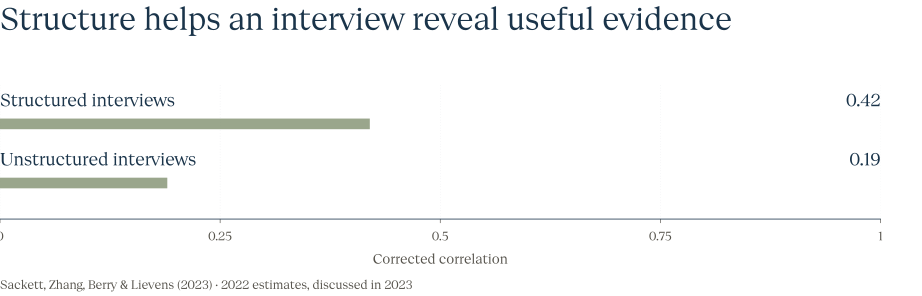
Structure helps an interview reveal useful evidence


Prepare examples that answer a clear question. A relaxed conversation can still have a thoughtful structure.
Sources & calculation notes
Source: Sackett, Zhang, Berry & Lievens (2023)
Not success percentages. Results vary: structured interviews have an 80% credibility interval of .18–.66. These are group estimates, not guarantees.
- Population
- Meta-analytic estimates across employment settings.
- Measure
- Corrected mean correlation with overall job performance.
- Source location
- Table 1, p. 285; variability discussion, p. 292.
- Checked
| Group | Value |
|---|---|
| Structured interviews | 0.42 |
| Unstructured interviews | 0.19 |
Make the process legible across an ocean
Allow for time zones, travel, and immigration planning. Share stage names, expected timing, and who decides. If a round is evaluative, do not call it “just a coffee” and then score it.
Be explicit about compensation timing. US candidates often expect range discussion earlier; Dutch teams sometimes wait. Pick an approach and apply it consistently. Surprising someone with a low figure after four deep rounds wastes goodwill on both sides. Related pay-conversation habits are discussed in asking about pay early.
Share who else is on the panel and what each conversation covers. Candidates preparing across a time difference deserve that map. It also stops interviewers from accidentally repeating the same behavioural prompt four times while missing the one risk you care about.
If someone is interviewing while still employed in the US, respect confidentiality and scheduling limits. A process that only works for people who can vanish for two days of onsite loops will filter your pool in ways you may not intend.
Separate fluency from judgment.
US interview practice can look like readiness.

Narrative fluency
Notice it, then ask for concrete ownership.
Startup constraints
Test judgment against your real limits.
A fairer read of the candidate
Score the role evidence you agreed in advance.
Decide with shared criteria
- Agree the must-have evidence before the first interview. Write it where the panel can see it.
- Score against the role, then discuss. Discuss the examples behind each score.
- Separate “can do the work,” “will do the work here,” and “we can support the move.” Immigration feasibility is real; it is not a substitute for interview judgment, and interview charm is not a substitute for lawful-work planning.
- Give clear outcomes. A slow maybe is expensive for a candidate considering relocation.
- Offer useful substance when you decline after substantive interviews. See writing a clear rejection.
For hiring teams
Your interview is also a preview of how you lead. Disorganized loops, contradictory feedback, and unexplained delays teach US candidates what joining would feel like.
Train interviewers on scope questions and on not treating US company names as levels. Practise one debrief using a real past candidate anonymized. Check that interviewers are applying the agreed criteria.
By the debrief, you should be able to describe more than who gave the smoothest answers. You should have examples of how the person reasons and a clear view of the work they could take on. The candidate should have learned something equally useful about you.
About this essay
Based on client questions, with details omitted and examples adapted. Research sources and methods appear alongside the chart.