The rejection email is still part of your reputation
What rejection messages communicate, what they don’t, and how hiring teams can be clear without becoming careless.
Updated
By the time a rejection arrives, someone may already have pictured a different working life. They have met the team, made room for interviews, perhaps told a person close to them that this one feels promising. Then a few lines of email bring the process to an end.
In coaching conversations, the unanswered questions can linger longer than the decision. I want hiring teams to remember the time and hope on the other side of the message. A clear answer, given with care, helps someone begin to turn their attention elsewhere.
Clarity is part of care
A rejection has a straightforward job. It should tell the candidate that this application is not progressing. If the decision is final, the message should make that clear. If another role or a future application is genuinely possible, it should explain what that means without making a promise the employer cannot keep.
Warmth can help, but it cannot make up for an unclear answer. A long paragraph praising someone’s experience may leave them wondering whether there has been a mistake if the actual decision is buried underneath. A short message can be respectful when it is clear and suited to the time you have spent together.
The amount of contact matters too. Someone who submitted an application has a different relationship with the employer from someone who has spent hours in interviews or completed a substantial exercise. The communication should acknowledge that investment without pretending that every candidate can receive the same level of individual feedback.
State the decision early, thank the person for their time, and explain whether there is a next step.
Separate the answer from the story.
A short rejection leaves many questions unanswered.

What you know
This application is not going further. A reason may or may not be given.
What you do not know
The full discussion, your chances elsewhere, or what every employer thinks.
Respond to the information you have
Try not to make one email explain your whole career.
A standard email cannot explain everything
From the candidate’s side, a short message creates a vacuum. It is tempting to fill it with a complete explanation: I am too senior, not senior enough, too unfamiliar, too different. The template rarely contains enough evidence to support any of those conclusions.
Sometimes a rejection includes a specific reason. Even then, it may describe only one part of a decision. Treat it as information to consider alongside other conversations, not as a final judgment about every role you could do.
This is easier to say than to practice. A job search asks you to care enough to prepare, while accepting that many outcomes will arrive with very little explanation. A useful boundary is to separate the decision from the story you are telling yourself about it. “This process ended” is a fact. The larger interpretation may still be uncertain.
If the same concrete concern comes up repeatedly in detailed conversations, investigate it. Several standard emails saying no are not the same as several interviewers naming a specific skill you need to work on.
| Question | What a brief rejection can establish | What it usually cannot establish on its own |
|---|---|---|
| Outcome | This application is not progressing | Your prospects across the wider market |
| Reason | A reason, if one is actually provided | The full discussion behind the decision |
| Culture | Something about this communication | Whether a whole country is direct or caring |
Before asking for feedback, it is worth giving yourself a little space. You may want an explanation, or simply wish the outcome had been different. Both feelings make sense. A question sent after that first disappointment has settled is often easier for someone to answer, and easier for you to hear.
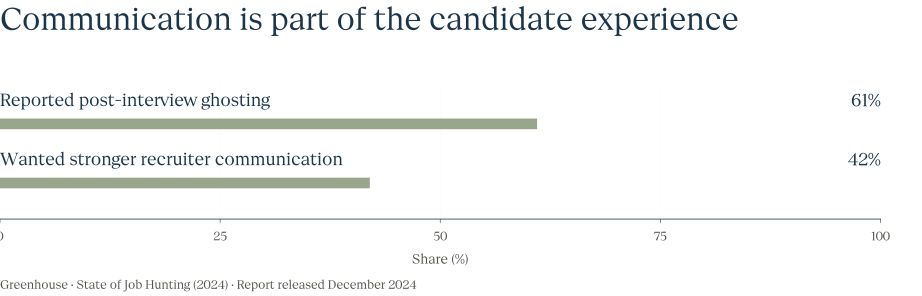
Communication is part of the candidate experience


A clear no gives someone information they can use. Silence leaves the process open in their mind.
Sources & calculation notes
Source: Greenhouse · State of Job Hunting (2024)
Overlapping groups: do not add the bars. The public summary does not provide the denominator for each item or a probability-sampling method.
- Population
- Survey of 2,500 workers across the US, UK and Germany.
- Measure
- Two separate self-reported survey measures.
- Source location
- “Ghosting…” section and “Next steps for TA teams”.
- Checked
| Group | Value |
|---|---|
| Reported post-interview ghosting | 61% |
| Wanted stronger recruiter communication | 42% |
Ask for feedback where a conversation exists
After a real interview, a short request for feedback can be reasonable. Make it specific enough to answer. “Was there a skill you needed a clearer example of?” gives the other person a clearer task than “Why didn’t you choose me?”
You may still receive no answer. The person may have limited information, limited time, or restrictions on what they can share. That can be disappointing without requiring you to pursue the explanation indefinitely. After one unanswered request, it is usually time to move on.
If you want to remain in touch, say so plainly and without making the recipient responsible for your next opportunity. A gracious reply is useful when there is a relationship to preserve. It is not an obligation to demonstrate perfect calm to every unattended mailbox.
You can also decide that the process has given you enough information about how you would like to be treated. That decision does not require a public accusation or a claim about the employer’s motives.
Take what helps. Close the loop.
You can leave room for learning without staying in a process that has ended.

Read
Find the decision, reason, and any real next step.
Ask once
After an interview, a specific feedback question may help.
Keep
Save useful feedback and look for repeated, clear themes.
Close
Update your record and move to the next opportunity.
Decide what to do next
You may still feel disappointed. You can also decide what needs your attention next.
Four ways to respond without getting stuck
- Identify what the message actually says. Separate the outcome, any specific reason, and any genuine next step. Do not treat standard praise or a vague invitation to stay in touch as an active opportunity.
- Ask once when feedback could help. Prefer a concise question after meaningful human contact. Make it easy to answer, and leave room for the possibility that no useful explanation will be available.
- Look for patterns in evidence. Several interviews raising the same skill gap deserve attention. Several generic rejections may simply tell you that several processes ended. Keep those categories separate.
- Close the loop in your own system. Update the application record, save any useful feedback, and decide whether there is a future action. Give the result a place so that you do not have to keep reconsidering it.
For hiring teams
Write the message you can stand behind. A simple structure is enough: state the decision, acknowledge the person’s time, and explain any real next step. Adapt the level of detail to the stage of the process. Do not offer feedback if nobody is available to provide it.
If replies are not monitored, say so and give an appropriate contact route where one exists. After substantial interviews, consider whether a human conversation is warranted. Give the person a chance to ask a question if someone is available to answer it.
The candidate may forget the wording of the email and remember that somebody took the time. They knew the answer, their effort was acknowledged, and they could ask a question. Even when the relationship ends here, it deserves a considerate ending.
About this essay
Based on client conversations, with identifying details omitted and examples adapted for clarity.