You hire in English. Can people build a career in it?
Ask where language matters in the actual work: decisions, relationships, responsibilities, and opportunities to progress.
Updated
An English-language interview can make a Dutch workplace feel immediately accessible. You understand each other, the role sounds interesting, and the conversation moves easily. It is natural to imagine the working day will feel much the same.
Clients considering a move need to look a little further ahead. What happens in a hurried customer call, a difficult employee conversation, or a discussion about promotion? I want them to be able to picture participating in those moments, as well as getting through the first week.
Start with situations, not a label
“English-speaking company” can mean several things. The company may use English for formal presentations while some teams work mainly in Dutch. A particular function may operate internationally while the colleagues it works with do not. An interviewer may be comfortable speaking English while the role requires reading documents in another language.
Ask about the meetings, documents, and conversations you would handle each week.
Which language is used in recurring team meetings? In written decisions? With the people you would support? In the documents you would be expected to interpret independently? The answers may differ, and those differences matter more than the label on the careers page.
A clear requirement can help you make a good decision even when the answer is not the one you hoped for. An unclear requirement can leave both sides disappointed after an enthusiastic hiring conversation.
Ask where language enters the work.
“Everyone speaks English” is less useful than a description of an ordinary week.

Everyday teamwork
Meetings, written decisions, and informal updates.
Specialist work
Sensitive conversations, formal documents, and professional judgment.
Future responsibility
New teams, leadership work, and opportunities to progress.
A picture of the actual job
Which language is needed in each situation, and what support is available?
Ask about sensitive or specialist work
If a role involves supporting employees, advising managers, or working with employment-related material, ask how language is handled in those responsibilities. Which conversations require fluency? Which documents need specialist interpretation? What support is available, and who is responsible for the final judgment?
Do not assume that being able to hold an everyday conversation is the same as being able to handle a sensitive professional discussion. Equally, do not assume that every People role has identical language requirements. The work, people involved, and way the team is organized can differ substantially.
Ask which tasks actually require Dutch. Some may need fluency; others may be done well in English. A candidate should be able to ask about that respectfully. An employer should be able to explain the requirement with examples, instead of leaving someone to guess what “good enough” means.
This also protects against accidental overpromising. If a role requires language capability you do not yet have, a vague intention to learn is not a substitute for a workable plan agreed by both sides.
| Situation | In a familiar-language workplace | In a multilingual Dutch role |
|---|---|---|
| Everyday meetings | Some expectations may be taken for granted | Ask which language the team actually uses |
| Specialist responsibilities | Clarify technical and professional demands | Clarify both professional and language demands |
| Progression | Ask how readiness is assessed | Ask whether future scope adds language requirements |
The question becomes more personal once you imagine growing in the role. You might be comfortable joining today and still wonder which doors will be open in two years. That is a fair conversation to have before moving, and a useful one for a founder who hopes this person will stay.
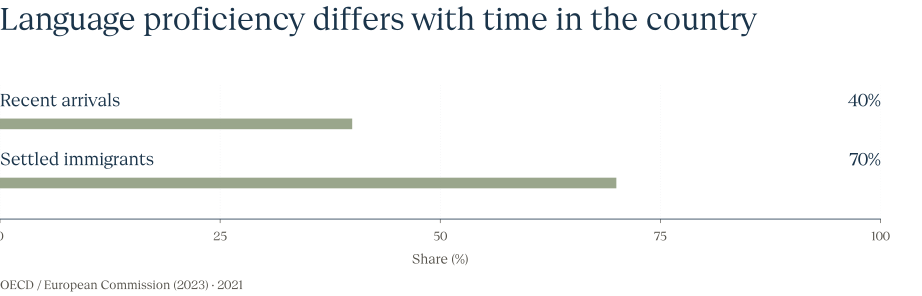
Language proficiency differs with time in the country


Ask what language the work requires today, and what support exists for learning.
Sources & calculation notes
Source: OECD / European Commission (2023)
Different groups, not the same people followed over time. Figures are rounded; they do not measure readiness for a particular job.
- Population
- EU foreign-born residents aged 15–64; source’s residence groups.
- Measure
- Self-reported advanced host-country language skills, including mother-tongue speakers.
- Source location
- Indicator 3.3, definition and main findings.
- Checked
| Group | Value |
|---|---|
| Recent arrivals | 40% |
| Settled immigrants | 70% |
Ask about the work after onboarding
An interview can concentrate on whether you can start. A better conversation also considers whether you can grow. Would a move into another team require a different level of language ability? Would leadership responsibilities bring new stakeholders or documents? Is there time and support for learning if that becomes relevant?
Discuss language alongside the other capabilities required for the next level. Agree what support and time would be available to learn.
There is also the everyday experience of participating. How are important informal discussions brought back into shared channels? If someone misses a conversation because it happened in a language they do not understand, how do they receive the decision and its context?
A team does not have to eliminate every informal interaction in another language. It does need a reliable way to make work-relevant information accessible to the people responsible for acting on it. Write down the decision and share it in a language the responsible team can work in.
Turn a reassurance into a plan.
If learning is part of the arrangement, make the expectations clear on both sides.

Ability now
What can you comfortably handle today?
Work required
Which situations need a different level of fluency?
Support offered
Who helps, what time is available, and when will you review progress?
An agreement both sides understand
A general promise to improve is not enough for work that needs fluency now.
Questions to take into the process
- Ask about recurring situations. Request examples of the meetings, written work, and conversations with colleagues and customers you would handle. A description of an ordinary week is more useful than a broad statement that everyone speaks English.
- Distinguish current ability from future learning. Describe what you can do accurately. If language development is part of the arrangement, discuss the expected level, support, and timing rather than relying on a general promise to improve.
- Clarify specialist responsibilities. For sensitive employee matters or formal documents, ask who provides expertise and what you would be expected to handle independently. Do not let an informal reassurance replace a clear answer about who does what.
- Ask about progression. Find out whether broader scope would involve different language demands.
- Notice how information travels. Ask how decisions are documented and shared across the team. A consistent written record can help everyone, including people who missed a meeting for reasons unrelated to language.
For hiring teams
Write requirements in terms of the work. “English is sufficient for these responsibilities; Dutch is required for these conversations” gives applicants a much clearer basis for deciding than “international environment” followed by an unexplained language filter.
Apply the stated criteria consistently. If a requirement is flexible, explain what support makes that possible. If it is essential, say so early. Candidates can work with a boundary they understand. Discovering a different boundary late in the process is much harder.
People settle into work more easily when they know how to take part. A founder who explains the language expectations, and makes time for learning where it is needed, gives a new colleague a clearer view of their future. The invitation to join should reach beyond the first day.
About this essay
Based on client conversations, with identifying details omitted and examples adapted for clarity.