Before you ask for more performance, decide what can wait
Clear priorities, explicit decisions, and a useful way to say no. A practical approach to leading across different work expectations.
Updated
At Design Dept., I coached new and experienced design leaders. The question of how to help people do good work kept bringing me back to something very ordinary: a week with too much in it. Several projects mattered, several people were waiting, and nobody had said what could move.
My product experience and psychology studies give me different ways to think about this, but I still want to begin with the team’s actual week. What are people trying to finish? Where are they getting stuck? What decision from their manager would make tomorrow more workable?
Decide what comes first
A list of important projects is not yet a set of priorities. Setting priorities means telling people what should happen first, what can wait, and what will not happen with the resources available.
Without those choices, people quietly find their own ways to cope. One works longer hours. Another rushes a task. Someone else delays work a colleague is waiting for. Everyone may have agreed to the same list, but they are now following different plans. I want those choices to be discussed openly.
A better conversation makes the constraint visible. “We can complete this by Friday if we postpone that review” is more useful than a reluctant yes followed by an invisible compromise. It gives the person responsible for priorities a decision to make.
Once a decision is made, update the plan so the team knows what to deliver and what to postpone.
A new priority needs a choice.
When the team is already committed, adding work changes the plan.

Keep the existing plan
Let the new request wait, reduce it, or decline it.
Take on the new work
Agree what moves: another task, a deadline, the scope, or support.
Make the choice together
Do not leave each person to solve the conflict through hidden extra work.
Explain how decisions are made here
Someone joining a team may read a meeting differently from the people already there. They might think everyone is still deciding what to do. Others may think the decision is settled and they are planning how to carry it out. I would make that difference clear at the start.
Neither person needs to be unreasonable for confusion to follow. The team has simply left an important rule unstated. International moves can make that difference more visible, but the same mismatch can happen between two departments in one company.
When a team talks about overleg, I ask what happens during that discussion. Who contributes? Who decides? What happens when there is no consensus? When is the discussion finished?
People can have a say without everyone needing to agree. I want the team to know who is listening, who will make the final call, and when we will move forward.
| When this happens | Discuss | Agree |
|---|---|---|
| Another urgent request arrives | Which existing work would be delayed? | The priority and revised dates |
| A decision stalls | Whose input is still needed? | Who decides and when |
| A new hire starts | What should they deliver first? | Scope and review dates |
| A tool changes the work | What is faster and what still needs review? | A revised workload based on the actual change |
I care about the moment someone feels able to say that the plan no longer fits. It takes trust to raise that before a deadline is missed. How I respond as a leader helps determine whether I will hear about the next problem early enough to do something useful.
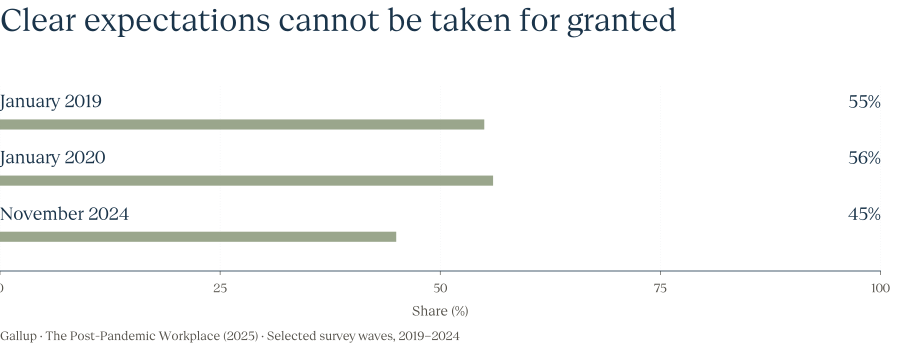
Clear expectations cannot be taken for granted


I want priorities and responsibilities to be clear before a performance review, not first explained during it.
Sources & calculation notes
Source: Gallup · The Post-Pandemic Workplace (2025)
Selected waves, not annual averages. Descriptive survey results do not show what caused the change.
- Population
- US employees; item-level sample sizes not stated in the article.
- Measure
- Share strongly agreeing that they know what is expected at work.
- Source location
- Table “Less Than Half of U.S. Employees Know What’s Expected…”; January 2019/2020 and November 2024 rows.
- Checked
| Group | Value |
|---|---|
| January 2019 | 55% |
| January 2020 | 56% |
| November 2024 | 45% |
Explain what good work looks like
Performance expectations should help someone decide how to work before they receive a rating. If the criteria become clear only at review time, the process is asking people to work out too late what was expected.
For a new hire, ask which outcomes matter, how collaboration is assessed, and what evidence will be considered. For a manager, check whether the expectations are compatible with one another. A team cannot at the same time treat every request as urgent and expect uninterrupted focus without some way to resolve the conflict.
New tools make this conversation more necessary. If AI changes how quickly one task can be done, it does not automatically remove the need for review, judgment, coordination, or learning. Ask which part of the work has changed before treating the entire job as time available for more work.
I would look at the task itself. What has become faster? What still needs careful thought? Who checks the result? Those answers tell us more about the time available than a broad claim about what a new tool can do.
Give a decision a clear route.
People can contribute without every choice needing everyone’s agreement.

Ask
Whose input is needed?
Decide
Who makes the call, and by when?
Share
Who needs the decision and the reasons?
Revisit
What change would make us look again?
Less guessing about who does what
Explain the route before the team has to work it out under pressure.
Five questions to keep asking
- Agree the outcome before the deadline. Describe what needs to be true when the work is complete. Clarify the level of quality and the dependencies, so that a date does not stand in for an entire agreement.
- Talk about what has to give. When another request arrives, identify what would have to wait. Offer options with consequences rather than accepting every commitment and hoping the conflict resolves itself.
- Name the person who decides. Consultation is more useful when everyone knows who will decide and when. Explain whose input is needed and how the outcome will be communicated to people who were not in the room.
- Review capacity when the work changes. A new project, a changed tool, or an unexpected dependency can alter the original plan. Revisit the commitment openly instead of making adjustment feel like a personal failure.
- Discuss performance throughout the work. Use concrete examples and agreed expectations. A formal review should not be the first time someone learns what their manager considers a good contribution.
For hiring teams
Include the unwritten rules in onboarding. Explain how to disagree, how to raise a capacity problem, and how decisions become final. Give examples of what a useful challenge sounds like. Do not leave people to guess these rules from nationality or from the person who speaks most confidently in a meeting.
I want a team to leave a planning conversation knowing what it can put down as well as what it will carry forward. That clarity gives people a better chance of doing work they are proud of, and of coming back tomorrow with the attention it needs.
About this essay
These questions draw on my leadership coaching and ongoing studies. The illustrations offer ways to prepare a team conversation; research sources accompany the chart.