If the salary is a mystery, the conversation starts in the wrong place
When the range is missing, ask for it early. A practical approach to pay conversations across the US and Dutch job markets.
Updated
There is a point in a promising job conversation when you begin to picture yourself there. You can imagine the team, the problem you would work on, perhaps even the journey to the office. It is an awkward moment to discover that the salary was never going to work.
In client conversations about moving between the US and the Netherlands, that uncertainty takes up more room than it should. Asking about money can feel like interrupting the enthusiasm. Yet a person considering a move needs to know whether they can build a life around the offer. I want that question to feel welcome from the beginning.
The missing number changes the conversation
An advertised range does more than tell you what a job pays. It gives you a first clue about the responsibility the employer expects. A big gap between the responsibility and the pay is useful to discover before you arrange an interview, prepare examples, and imagine yourself in the role.
Without a range, candidates have to work out whether the company is hiring for the job described, a smaller version of it, or a role whose budget has not really been settled. Ask which version of the role the team has budgeted for.
If the number is missing, curiosity is a useful place to start. The company might have a fixed pay scale, be choosing between two levels, or still be working out its budget. It might simply be used to leaving pay out of job ads. You cannot tell from the omission alone.
Find out whether the pay could work.
Before investing time in an interview, find out whether the offer could work for you.

The range is shared
Check the responsibilities and what the pay includes.
The range is missing
Ask for the budget before trying to name your price.
Can this role meet my needs?
A clearer question once both sides have the same information.
Ask about the role before pricing yourself
I would suggest asking: “What is the salary range for this role? What decides where someone falls within it?” These questions start with the job and its budget. You do not have to begin by naming a number or explaining what you earned in your last role.
If the answer is “it depends on experience,” ask what that means in practice. What would someone at the top of the range be expected to do? Would they make different decisions or support more teams? The number is more useful when you understand the job that goes with it.
You can also ask whether the figure is monthly or annual, what working hours it assumes, and which elements are included. Put each offer on the same basis before comparing the figures. Keep the answer in writing so that later conversations begin from the same understanding.
| Question | US opportunity in this scenario | Dutch opportunity in this scenario |
|---|---|---|
| What was visible at first? | Base and equity ranges | No stated pay range |
| What can the client assess? | Initial pay fit | Role description, with pay still unknown |
| What still needed asking? | Scope and package details | Budget, scope, and package details |
Once the budget is on the table, the conversation has somewhere to go. You can spend your attention on the work, ask better questions about the team, and decide how much of yourself to invest. Even a disappointing answer can give you back an afternoon you would otherwise spend wondering.
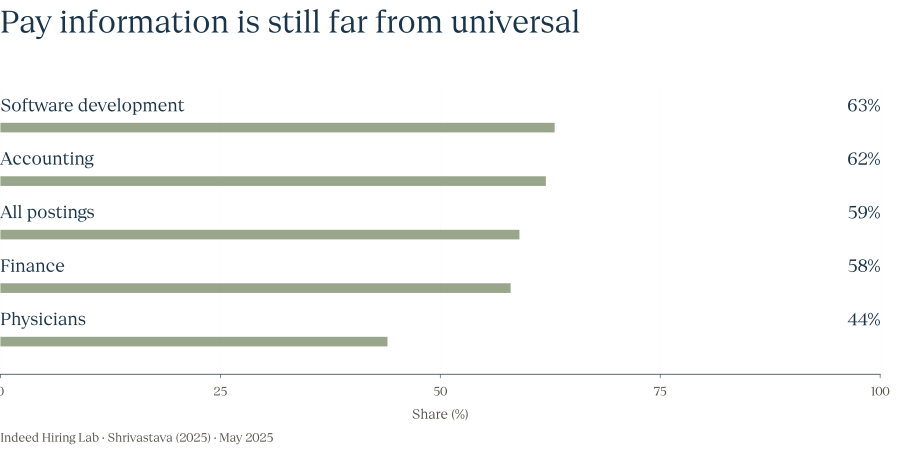
Pay information is still far from universal


Even in software development, a missing range is not unusual. Asking early fills a real information gap.
Sources & calculation notes
Source: Indeed Hiring Lab · Shrivastava (2025)
Platform coverage, not all US vacancies. The national figure includes the sectors shown; these are not separate parts of a whole.
- Population
- US job postings on Indeed; millions of listings.
- Measure
- Share of postings showing salary information.
- Source location
- Release dated 2 July 2025, sector bullet points.
- Checked
| Group | Value |
|---|---|
| Software development | 63% |
| Accounting | 62% |
| All postings | 59% |
| Finance | 58% |
| Physicians | 44% |
Transparency is changing, but check the date
There is a wider push to make these conversations easier. The Dutch pay-transparency proposal would require starting-pay information and prevent questions about salary history. In October 2026, the intended start was 1 January 2027, still subject to parliamentary approval.
In the US, some candidates are already used to seeing a range because of local requirements, including those covering certain Illinois postings. The rules vary by location, which helps explain why expectations can differ before the first call.
Ask for the range in the first detailed conversation. A hiring team can provide it while the legislation is still being considered.
Put the numbers on the same basis.
A headline salary is only the start of a useful comparison.

Time
Monthly or annual pay? For how many hours each week?
Reliable income
What is guaranteed? What depends on performance or other conditions?
The rest
Pension, holiday allowance, shares, leave, and learning support.
Compare the whole offer
Ask what each item means. Do not assume equal labels mean equal benefits.
Four things to do before the offer
- Ask early. Raise the budget in the first detailed conversation, alongside scope and expectations. A useful introduction is: “To make sure we’re aligned before we go further…” You are checking whether the role works for both sides. That is a normal part of the conversation.
- Compare the whole arrangement. Ask how base pay, working hours, pension contributions, holiday allowance, bonuses or other variable pay, and learning support are described in this particular offer. Do not assume the same labels include the same things across countries or employers.
- Decide what matters to you. Research comparable roles and write down the responsibilities you want, the trade-offs you can make, and the questions still unanswered. Your previous salary alone cannot establish what a different job in a different market should pay.
- Notice answers that stay unclear. A recruiter may genuinely need to check a figure. Agree when they will return with it. If the answer remains unavailable after several conversations, include that uncertainty in your decision about how much more time to invest.
For hiring teams
Publish a meaningful range, explain the level, and state what the figure includes. If you are still deciding between two levels, say so. Give candidates enough information to decide whether to continue.
The same principle applies inside the interview. Let people ask about pay without making the question a test of their motivation. Wanting to understand the terms of employment is compatible with caring deeply about the work. Answer it as you would any other question about the role.
Imagine that first conversation again, with the range already clear. There is room to be curious about the work because neither person is quietly waiting for the financial surprise. That is a more generous way to begin a possible working relationship.
About this essay
Based on client conversations, with identifying details omitted and examples adapted for clarity. Official pay-transparency sources were checked on 30 October 2026; consult current guidance before relying on a rule.