Your Dutch offer may be worth more than your US candidate can see
Help US candidates understand Dutch leave, holiday allowance, probation, and notice—without turning hiring managers into lawyers.
Updated
A candidate opens a Dutch offer and starts with the number they recognize: the salary. Around it are terms that may be less familiar—holiday allowance, pension contributions, probation, notice. Some may sound like extras. Others may seem too ordinary to ask about.
I would make time to read the offer together. Moving from a San Francisco compensation conversation into a Dutch one involves more than converting a currency. The person needs to understand how pay arrives, how time off works, and what they can expect when life or work becomes difficult.
Explain what comes with the contract
A Dutch employment contract sits inside statutory rules and, in some companies, a collective agreement. Managers do not need to recite the Civil Code. They do need to know which parts of the offer are company choices and which parts are required frameworks.
Business.gov.nl summarises employer obligations around contracts, leave, and related topics for companies operating in the Netherlands. Use it as a map to the official explanations, then confirm details with HR counsel for your situation. Browse the staff and employment guidance.
Tell candidates when something is a legal minimum, when you offer more, and when a term depends on a collective agreement. That helps candidates understand both the legal protections and what your company offers beyond them.
Translate the Dutch terms.
Do not assume US candidates already know the vocabulary.

Leave
Statutory minimums and any company top-up.
Holiday allowance
How it is calculated and when it is paid.
Probation
Whether it applies, how long, and what you evaluate.
An offer that can be compared
Separate legal floors from company extras.
Leave, holiday allowance, and working time
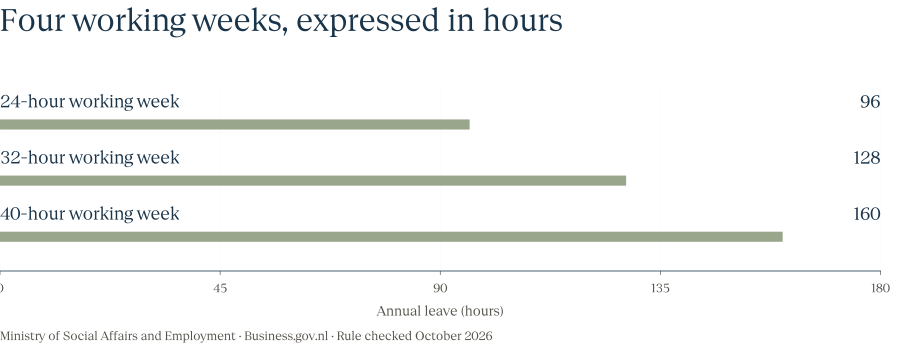
Dutch employees have a statutory annual-leave minimum equivalent to four times the weekly working hours—for example, 160 hours for a 40-hour week—unless a more favourable arrangement applies. Contracts can provide more. Read the government leave guidance.
Holiday allowance is easy to misunderstand. Candidates may hear “8%” and think bonus. Explain how it is calculated in your company, when it is paid, and whether the quoted salary already illustrates it separately. Do not assume a US reader knows the term.
Working hours and overtime culture also need a plain sentence. A candidate used to unpaid evening Slack may misread a 40-hour contract as either rigid or fictional. Describe how your team actually handles deadlines, on-call, and recovery time. If overtime is common, explain when it happens and how it is handled.
In the US, the federal FLSA framework does not require private-sector paid vacation in the way many candidates assume is universal; employer policy and other applicable rules matter. Pointing at US Department of Labor leave topics can help a candidate check the federal position alongside their own employment terms.
It is often the ordinary example that makes a term understandable. Walk through a month’s pay, a planned holiday, or the first review. Invite the questions that feel basic. They are much easier to answer now than after someone has built a household budget around a misunderstanding.
Four working weeks, expressed in hours


Different hours, the same four-week minimum.
Sources & calculation notes
Source: Ministry of Social Affairs and Employment · Business.gov.nl
A statutory minimum, not observed employer benefits. Additional leave may apply.
- Population
- Illustrative weekly schedules for a full year of employment.
- Measure
- Derived calculation: weekly working hours × 4.
- Source location
- How many statutory holiday days are your employees entitled to?
- Checked
| Group | Value |
|---|---|
| 24-hour working week | 96 hours |
| 32-hour working week | 128 hours |
| 40-hour working week | 160 hours |
Probation, notice, and ending employment
Probationary periods, where allowed, change how early exits work. Explain whether there is one, how long it lasts, and what “passing” looks like in practice. Silence here creates anxiety for people who have only known informal US ramp periods.
Dismissal and ending employment follow Dutch procedures that differ from many US at-will expectations. Business.gov.nl explains dismissal routes at a high level. See the dismissal procedures overview. This is context for candidates and a reminder for managers: do not invent assurances about permanence or exit terms. Point to HR and counsel.
Leave time for contract questions and introduce the HR or legal contact who can answer them. Be clear about which arrangements apply to this role.
| Term | What to explain | Common US misread |
|---|---|---|
| Holiday allowance | Rate, timing, and whether shown inside or beside base pay | “Guaranteed bonus” or “irrelevant admin” |
| Statutory leave | Minimum hours and any company top-up | Assuming vacation is purely discretionary |
| Probation | Length and evaluation criteria | Treating it like a meaningless formality |
| Notice / dismissal | That procedures exist; details via HR | Assuming US-style at-will either way |
Send a one-page glossary.
Put the terms beside the numbers before the verbal close.

Show the units
Monthly and annual views, with hours stated.
Name the owner
Who answers contract questions after the call?
Leave room for advice
Tax and personal situations need specialists.
Fewer surprises after signing
Leave time for questions before the candidate signs.
Write terms candidates can actually use
- Give a one-page glossary with the offer: leave, holiday allowance, pension, probation, notice, and equity.
- Show an example monthly and annual view in euros, with hours stated.
- Separate statutory floors from company extras in two short lists.
- Introduce the person who can answer contract questions; do not leave every clarification to the founder’s inbox.
- Invite the candidate to take advice on tax and social security interactions. You can explain the employment terms you offer without advising on their personal US filing position. The IRS overview for citizens and resident aliens abroad can help them prepare questions for an adviser: IRS international taxpayers.
For hiring teams
Clear terms reduce renegotiation after arrival. People who feel surprised by pay timing, leave booking, or probation reviews rarely blame “the Dutch system” alone. They blame the company that failed to explain it.
The offer should be a document the person can return to and understand. Reading it together gives you a chance to begin the working relationship with patience and clarity. It is time well spent before asking someone to sign.
About this essay
Based on client questions, with details omitted and examples adapted. Employment guidance was checked on 30 October 2026. Have the contract reviewed for your company and the role.