Make your introduction easy to pass on
A warm introduction starts with a clear, generous request. How to build conversations when your local network is still new.
Updated
“Let me know if you hear of anything” is the sort of message you send when you would appreciate help but do not want to ask too much. After a move, there may be several people you could write to and very few you feel comfortable leaning on.
In client conversations about rebuilding a network, I try to make that first request feel smaller. You do not need someone to solve your career. You need a useful conversation, and a few sentences that help another person see who might enjoy having it with you.
The introduction is a small piece of work
When you ask for an introduction, you are asking someone to do several things. They have to understand your situation, think of a relevant person, decide whether the connection makes sense, and explain why. “Let me know if you hear of anything” leaves nearly all of that work with them.
A more specific request gives them something to use. Describe the kind of problem you want to work on, the relevant experience you bring, and the conversation you are hoping to have. It can be short. In fact, being able to express it briefly is often a useful test of whether you know what you are asking for.
For someone arriving in a new market, this can feel uncomfortable. You may be used to being the person who knows people, understands the landscape, or receives the inbound message. It takes time to build the local connections you previously relied on.
Make the next step easy.
A good introduction gives each person enough information to help.

Tell your contact
What you are exploring and why.
Offer a short note
Something they can forward, with permission.
Ask one question
Give the new person a clear reason to talk.
A useful conversation
Ask about the roles, teams, or skills you want to understand.
Try more than one way in
In the conversations behind this essay, opportunities came through both recruiter messages and personal introductions. Each offered different information: a defined role in one case, people who could help explain the market in another.
Both routes exist in both places. The practical question is whether your current search depends too heavily on a channel that is not producing the conversations you need. If you are new to the local market, a conversation may help you understand job titles, company needs, and expectations before you decide where to apply.
It can also reveal that your target needs refining. Someone might understand your experience perfectly and still tell you that the role you are describing lives under a different name. Use that information to refine the next search.
| Route | US route in this scenario | Dutch route in this scenario |
|---|---|---|
| Initial contact | An inbound recruiter message | A warm introduction and a personal update |
| Information available | A role and pay ranges | A reason to meet and possible connections |
| What it established | An opportunity to explore | A conversation, not a hiring outcome |
It helps to imagine the message arriving in an ordinary busy day. Your contact reads it between meetings and thinks of someone. Can they pass it on with confidence, or would they need to write your story for you? A little care with the paragraph makes the kindness easier to offer.
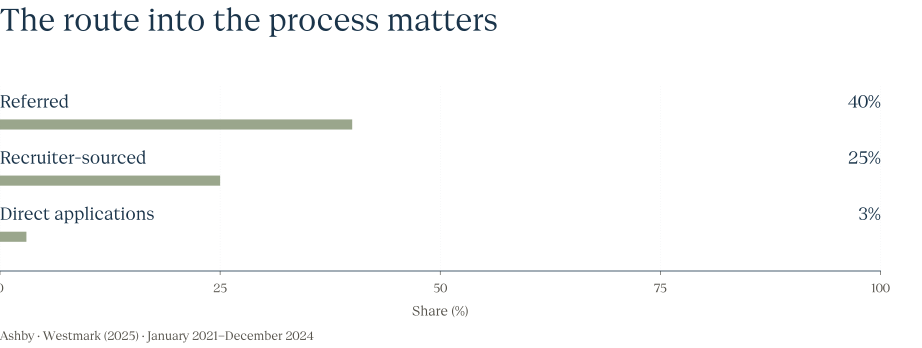
The route into the process matters


A connection can help someone reach a conversation. It is not a substitute for evidence that they can do the work.
Sources & calculation notes
Source: Ashby · Westmark (2025)
Observational platform data. Referral groups differ before applying; this does not measure the causal benefit of an introduction.
- Population
- 38M+ applications across 93K jobs at Ashby customers.
- Measure
- Application-to-interview rate, by source.
- Source location
- “Interviews: Which sources are selected to interview?” and accompanying chart.
- Checked
| Group | Value |
|---|---|
| Referred | 40% |
| Recruiter-sourced | 25% |
| Direct applications | 3% |
Write something that can travel
Here is a template the client could adapt: “I’m exploring roles in [function], especially work involving [problem]. My background is in [relevant experience]. I’d value a short conversation with someone who understands [specific question]. If anyone comes to mind, I can send a short introduction you’re welcome to forward.”
Keep the bracketed parts concrete. “Interesting opportunities with great people” asks the recipient to supply the entire idea. “How leadership-development work is organized in a growing technology company” gives them a topic and a possible person.
You can include a short bio and a link, but do not turn a favor into a document review. Ask before assuming someone is comfortable attaching their name to a recommendation. Give them an easy way to decline or suggest a different route.
The same restraint helps after the introduction. Thank the person who connected you, arrange the conversation directly, and avoid copying everyone into every scheduling exchange. If the discussion leads to a useful next step, a brief update closes the loop.
Three parts. One short note.
Help someone know who you are, where you are going, and how they might help.

Experience
“My background is in…”
Direction
“I’m exploring work involving…”
A clear ask
“I’d value a conversation about…”
A paragraph worth forwarding
Use specific work and real questions instead of a long career history.
Keep in touch with care
- Begin with people who already know something about your work. Send a specific update rather than a mass announcement. Explain what has changed and what you are exploring now, without expecting them to solve the search.
- Ask for understanding before access. “How is this work organized here?” can be a better opening than “Can you get me an interview?” It gives the other person a question they may actually be able to answer.
- Prepare one paragraph someone can forward. Include relevant experience, direction, and a clear reason to talk. Keep it accurate enough that you would be comfortable seeing it reach someone you have never met.
- Make the conversation worth having. Arrive with two or three questions, respect the time agreed, and share something useful when you can. Do not treat the person as a checkpoint on the way to someone more important.
- Follow up with care. A thank-you and a concise update are usually more useful than a sequence of vague reminders. If there is no reply, allow the relationship to remain a relationship rather than turning it into a campaign.
For hiring teams
An introduction can help someone get noticed. It should not let them skip the standards you use for other applicants. Explain what you are looking for, assess their work fairly, and keep a way in for people who do not know anyone at the company.
Someone has used a little of their trust to make the introduction. Honour that by giving the person a thoughtful conversation and a fair assessment of their work. Keep that same care for the applicant who found you without anyone to introduce them.
The first useful introduction may lead to an explanation rather than an interview. Someone gives a name to the work you want, points out a team you had missed, or helps you ask a better question. Those conversations are how a new professional world begins to feel less distant.
About this essay
Based on client conversations, with identifying details omitted and examples adapted for clarity.