Your next hire is already judging how you work
Response windows, application limits, and reapplication rules can change your search. Treat the process as useful information.
Updated
Five days have passed since the application confirmation. You open the email again. Did they mean working days? Was the clock supposed to start after the assessment? It is a small uncertainty, but it can follow someone through a whole week.
Clients bring these questions into conversations because they are trying to make plans around a process they cannot see. For a founder, that waiting period is an early part of the relationship. Someone is already learning what it feels like to depend on your team for an answer.
The process is part of the opportunity
A job description tells you what an employer wants. The hiring process tells you something about how it expects to reach a decision. Neither document promises what will happen, but both can help you decide how to spend your time.
Look for the sequence of stages, the expected time to reply, any assessment, and the point at which pay and working arrangements will be discussed. If an employer limits applications at the same time, that affects which roles you choose. If it restricts reapplication, that affects how you think about an application you are unsure about.
These details are easy to miss because they often live in different places: a careers page, the vacancy, a confirmation email, or the application portal. Bring them together before treating the process as a single, mysterious event called “waiting to hear back.”
Keep a short note of the next step and the date you expect to hear back.
Know what starts the clock.
A promised reply is useful only when you know what it refers to.

The starting point
Application sent, assessment finished, or interview completed?
The waiting period
Calendar days or working days?
The promised reply
Receipt confirmed, a decision, or the next invitation?
One follow-up date
Record the promise as stated, then get on with other applications.
Check what the timeline means
Five days and five working days are different windows. So are five days after submitting an application and five days after completing an assessment. If a timeline is unclear, identify what starts the clock and what the employer is promising to send.
Check whether the promised reply confirms receipt, gives a screening result, or invites you to the next stage. Each leaves you with a different next step.
I would record the promise in the employer’s own terms and give it a practical follow-up date. If the deadline moves, update the tracker once. Repeatedly refreshing a portal cannot make an unclear process clearer, and it creates the feeling of doing something without giving you new information.
A missed window can be a reason to follow up. It does not by itself reveal the cause. A delayed decision, an absent interviewer, a changed role, and an overloaded recruiting team can look identical from the outside.
| Process detail | Question to ask | What to record |
|---|---|---|
| Timing | When should I hear back, and about what? | The expected date and type of response |
| Assessment | What does it cover and how long should it take? | Instructions and deadline |
| Application limits | Can I apply for more than one role? | The current rule and roles you chose |
| Next stage | Who will contact whom? | Contact name and next action |
Once the next step has a date and an owner, waiting becomes a little easier to contain. A candidate can follow another lead or prepare for a different conversation. The hiring team gets fewer anxious follow-ups because it has given people something they can plan around.
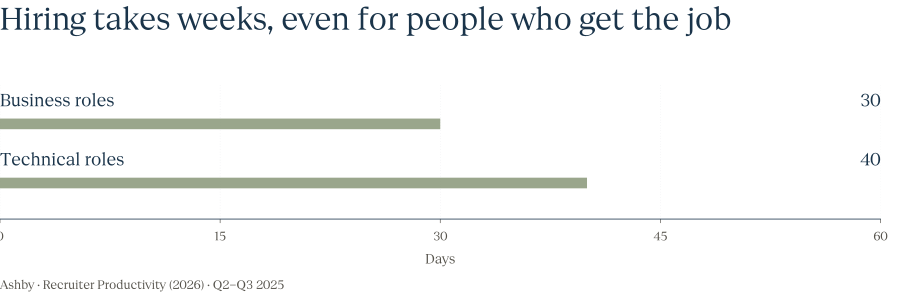
Hiring takes weeks, even for people who get the job


Use the employer’s own timeline when following up. A benchmark helps with perspective, not with guessing what silence means.
Sources & calculation notes
Source: Ashby · Recruiter Productivity (2026)
Completed hires only. These are not promised response times or a timetable for every applicant.
- Population
- Hired candidates at Ashby customers; subset size not reported.
- Measure
- Median days from application to accepted offer.
- Source location
- Part 4, table explicitly labelled “Q2–3 2025”.
- Checked
| Group | Value |
|---|---|
| Business roles | 30 days |
| Technical roles | 40 days |
Follow the actual rules
If an employer limits the number of applications, choose the roles with the closest fit. Focus on the roles where your experience and the stated need overlap most clearly. If two openings seem similar, asking which is more appropriate may be better than sending several versions of the same application.
A reapplication rule also deserves a literal reading. Check what it applies to, whether it is still current, and whether it concerns the same role or the employer more broadly. Do not assume a restriction from one process applies everywhere. Do not try to evade it through another account.
Check the current careers page before relying on instructions from an old email. Application limits and timelines can change.
There is another benefit to this approach: it keeps the search moving. Once you have a next action and a date, an application can wait in its own place rather than occupy the rest of the day.
Waiting needs a next step.
Give each application a place in your plan.

A date was given
Set a reminder. If it passes, ask whether the timeline has changed.
No date was given
Ask when to expect an update in your next conversation.
Keep other options moving
A promising application is still an open question.
Build a tracker you will actually use
- Record the minimum. Keep the role, application date, process link, stated time to reply, current stage, and next action. You do not need a complicated dashboard to know what is waiting and what needs attention.
- Save the relevant instructions. A brief note or a link is usually enough. Be especially clear about application caps, assessment deadlines, and any reapplication restriction before submitting.
- Follow up against the stated window. When it has passed, send one concise message asking whether there is an updated timeline. If no window was given, ask for one in the next human conversation.
- Keep several possible futures open. Until there is a decision you can rely on, continue appropriate conversations elsewhere. A promising process is still a process, and planning around it as a certainty adds avoidable pressure.
- Review the system weekly. Close out completed items, identify the few actions that matter, and leave the rest alone until the next review.
For hiring teams
Publish the stages and tell candidates what each stage is for. Make the timing clear, including what happens when it changes. A short update is more useful than a reassuring promise that nobody has responsibility for keeping.
Explain unusual rules where candidates will encounter them, before they invest effort. Put the instructions beside the application form, where everyone can find them.
Return to that unanswered email. A short, honest update could have changed the candidate’s week: here is where we are, here is what changed, here is when we will be in touch. Keeping that small promise is an early chance to earn trust.
About this essay
Based on client conversations, with identifying details omitted and examples adapted for clarity.