A career that adds up doesn’t have to follow a straight line
Coaching, studying, and exploring the next role can form a clear direction. The work is deciding what belongs together.
Updated
Building Bold Paths while studying Work and Organizational Psychology at VU Amsterdam asks me to explain a career that does not fit neatly into one line. Product work, coaching, and studying each have their own language. On a CV, they can look further apart than they feel to me.
The connection is in the questions I keep returning to. How do people find their footing in a team? What helps a leader make a difficult decision well? What makes good work possible over time? I am learning to describe that connection while leaving room for my understanding to change.
Your career does not need a straight line
A career history is usually presented backward from the present, with each role arranged neatly underneath the next. Living it is less orderly. Interests develop before a title changes. Learning can begin before you know exactly where it will lead. A move can make familiar work look different because the setting has changed.
The useful question is not whether every step was part of an original master plan. It is what you understand now about the work you want to do and the experience you can bring to it. You can tell that story honestly without pretending you predicted every turn.
I keep coming back to the conditions around the work. How are people led? How are teams organized? Who makes the decisions? My product background, coaching, and psychology studies give me different ways to explore those questions. Each adds something, while leaving things I still need to learn.
I find it helpful to be open about where I have experience and where I am still a student. There is something freeing about being able to bring what I know without having to claim that the learning is finished.
I was born in Boston, am a San Franciscan of Cape Verdean descent, and now live in the Netherlands. For a founder reading a background that crosses places and professions, I would ask what the person learned along the way and how they might use it in the role.
Different work. A shared question.
The connection I see across my own work and learning.
Product experience
Understanding how people work together to make something useful.
Leadership coaching
Helping leaders think through decisions and responsibilities.
Psychology studies
Learning how to ask better questions about people and work.
How can people do better work together?
A question that helps me choose what to pursue next.
Know why you want to learn
Going back to study does not mean starting again. For me, it is a way to look more closely at questions I already care about. I want to understand what the evidence says and bring better questions to the work of helping people and teams.
My master’s studies are ongoing. When I describe them, I explain what I am learning and how it relates to work I have already done.
The same standard applies to any learning plan. Ask what capability the learning is intended to develop, how it connects to the work you want, and what time it will require. A qualification can be useful without being a solution to every uncertainty in a transition.
It is also reasonable to discover that a particular opportunity does not fit right now. Choosing not to add another course or project can be evidence of direction. A transition does not need to become an endless collection of things that might eventually be useful.
| Commitment | What it contributes | What to decide |
|---|---|---|
| Ongoing work | Income, experience, and responsibility to others | How much time it needs each week |
| Study | Knowledge and methods for questions you want to investigate | How the learning connects to your work |
| A new project | A chance to test an idea | What would justify continuing it |
| A job search | Conversations about where you could contribute next | Which roles deserve preparation time |
There is some comfort in being able to name the connection without having every next step settled. I can choose what deserves time now and be honest about what I am still learning. That feels more useful than trying to make every earlier decision look inevitable.
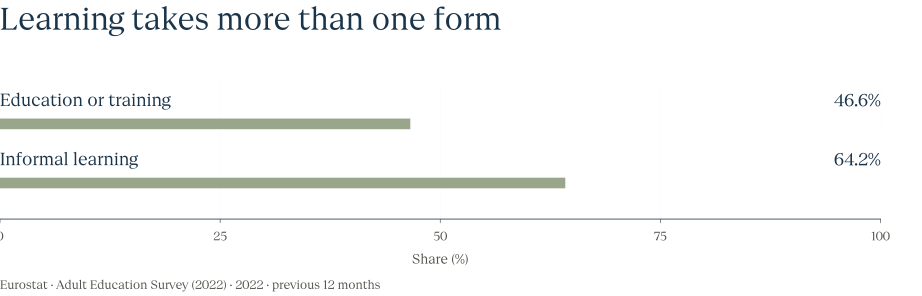
Learning takes more than one form


Study is one way to learn. The useful question is what each kind of learning adds to the work you want to do.
Sources & calculation notes
Source: Eurostat · Adult Education Survey (2022)
The groups overlap and must not be added. Participation says nothing by itself about career returns.
- Population
- EU adults aged 25–64.
- Measure
- Participation in formal/non-formal education or training, and in informal learning.
- Source location
- Education/training section and informal-learning section; data code trng_aes_100.
- Checked
| Group | Value |
|---|---|
| Education or training | 46.6% |
| Informal learning | 64.2% |
Give each commitment a job
When several activities matter, it helps to be clear about what each is for. Is a project a source of work, an experiment, a way to learn, or a commitment to other people? More than one answer may apply, but the answer should be explicit enough to guide decisions.
Otherwise, every activity can quietly become responsible for everything. A course must provide confidence, contacts, a new role, and a complete identity. A business must validate the whole transition. A job search must settle every question about the future. That is a great deal to ask of any one part of a life.
I find it more useful to ask what progress would look like in each area, then check whether there is room for all of it. I do not have a perfect system for this. Caring about several things still means deciding what to do now and what has to wait.
The capacity conversation applies here too. If a new opportunity enters, what changes? What can be postponed, reduced, or declined?
Give each commitment a job.
Before adding something new, be clear about what it is meant to do.

Purpose
Is this paid work, learning, an experiment, or a promise to someone?
Progress
What would make the time worthwhile?
Room
What needs to wait, shrink, or stop to make this possible?
A choice you can explain
Something can be interesting and still not belong in this chapter.
Tell one accurate story
- Name the question connecting your work. Make it concrete enough that another person can understand why your activities belong together. Avoid a slogan that could describe any career at all.
- Distinguish experience from direction. Explain what you have done, what you are studying, and what you want to do next. Readers should not have to infer which achievements are complete and which are plans.
- Give each commitment a purpose. Decide what the business, learning, or search is meant to contribute. Use that purpose to assess new requests rather than adding work simply because it sounds relevant.
- Set a capacity check before adding more. Look at the actual time and responsibilities involved. If something new matters, identify what will change elsewhere rather than relying on future energy to absorb it.
- Test the story with someone outside your context. Ask what they think you do and what work they would introduce you for. Their answer can reveal whether the connection is visible or still exists mainly in your own head.
For hiring teams
Ask about the connection between a candidate’s activities before deciding that a career that has changed direction means a lack of focus. There may be a clear direction worth understanding. There may also be practical questions about availability or competing commitments. Discuss those questions directly and in relation to the role.
Give candidates time to explain a change of direction, then ask how their experience relates to the work you need done.
When I look at these commitments together, I can see the questions taking shape across them. That gives me a way to choose the next piece of work. I do not need to know the whole future to recognize something worth continuing.
About this essay
A personal reflection on my work and ongoing studies. The learning data is attributed alongside the chart.