“Not enough relevant experience.” Relevant to what?
A familiar domain and transferable judgment are different forms of experience. Help a hiring team see which problem yours can solve.
Updated
“We chose someone with more relevant experience” can leave a candidate reading their CV all over again. The projects are still there. So are the years of work. What is harder to see is the connection the hiring team felt was missing.
When clients bring this question into a conversation, I want to slow down before rewriting the whole story. What was the employer trying to get done? Which part of the work was unfamiliar, and which part had this person handled before? Those questions give us a way back into the conversation.
Relevant to which problem?
Experience matters because it helps with the work ahead. A candidate might talk about how big their last company was. The hiring manager may be wondering something else: can this person handle the problem my team faces next month? Connecting those two conversations is part of the application.
Both concerns can be reasonable. Working through complexity can develop useful judgment. Knowing an industry can help someone recognize constraints and ask better questions. The difficulty comes when either side assumes that one kind of experience automatically demonstrates the other.
A large company name does not explain how close you were to the problem. A familiar industry label does not explain how well you handled it. A better conversation moves past both shortcuts and asks what the person actually did, under which conditions, with what result.
That is where I would focus the conversation. The client does not need to make their experience sound smaller. They need to show how it connects to this employer’s work, using examples the other person can understand and ask questions about.
Build the connection for the reader.
Do not leave a hiring manager to guess how your background could help.

Their problem
What does this role need to solve?
Your example
When have you handled something similar?
The difference
What would you still need to learn?
An honest case for the match
Explain the similarity without hiding what would be new.
Ask what is needed from the start
A useful question is: “What would someone need to understand quickly to be effective in this role?” The answer may identify a genuine requirement. It may also reveal that the job description’s broad language hides a much narrower immediate need.
For example, an employer might need someone who can navigate a particular group of people and their competing needs from the start. Another might need someone who has built a process where very little infrastructure exists. A third might value the ability to coordinate work across several established functions.
Once the requirement is clear, you can make an honest comparison. Which experience is close? Which is similar? What would you need to learn? Acknowledging the last category is useful. Claiming that everything transfers effortlessly prevents you from discussing the conditions that would make the transition work.
If the employer needs experience you do not have and cannot support the learning involved, another role may be a better fit.
| Question | Experience at scale can help explain | Industry experience can help explain |
|---|---|---|
| What have you encountered? | Complexity, dependencies, and coordination | Familiar constraints, customers, and vocabulary |
| What remains to be shown? | Your direct contribution and adaptability | Your judgment beyond a familiar setting |
| What should hiring assess? | Evidence against this role’s requirements | Evidence against the same requirements |
The most useful example is often quieter than the biggest achievement on the CV. Perhaps it is the time you made a difficult decision with incomplete information, or helped a team get unstuck. If that is the problem waiting in the new role, take the reader into the decision and show them how you approached it.
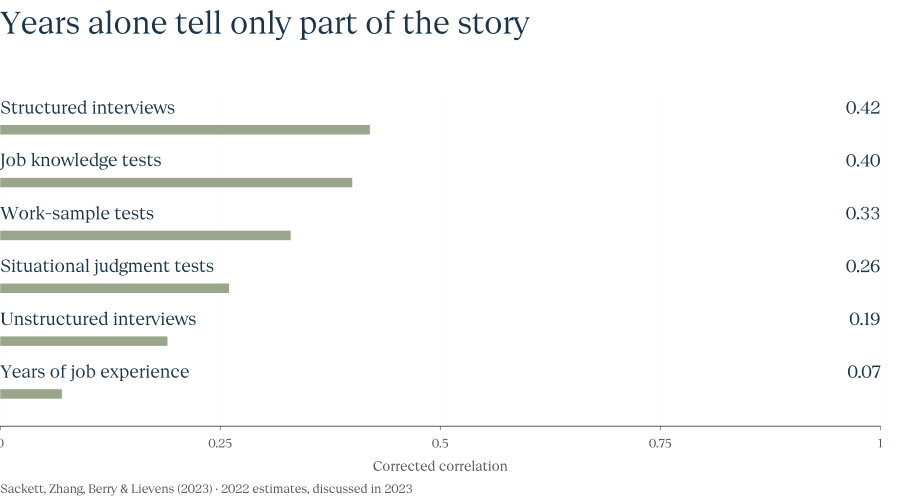
Years alone tell only part of the story


Ask consistent questions, check relevant knowledge, and watch someone work through a realistic task. Each gives you something a year count leaves out.
Sources & calculation notes
Source: Sackett, Zhang, Berry & Lievens (2023)
Each bar is a separate relationship with job performance. The values cannot be added together. Job-knowledge estimates come from existing employees.
- Population
- Meta-analytic estimates across employment settings.
- Measure
- Corrected mean correlation with overall job performance.
- Source location
- Table 1, p. 285: 2022 validity estimates for structured interviews, job knowledge, work samples, SJT (knowledge), unstructured interviews, and job experience.
- Checked
| Group | Value |
|---|---|
| Structured interviews | 0.42 |
| Job knowledge tests | 0.40 |
| Work-sample tests | 0.33 |
| Situational judgment tests | 0.26 |
| Unstructured interviews | 0.19 |
| Years of job experience | 0.07 |
Build the bridge in the application
Do not wait for the reader to discover the connection between your background and their problem. Lead with the closest relevant example, explain the similarity, and explain what would be new to you.
A useful structure is: “In that role, the problem was X. I was responsible for Y. Your description suggests a related challenge around Z.” The details matter more than the formula. If the similarity is weak, the sentence should make that visible to you before you send it.
Use the organization’s vocabulary where it accurately describes your work. Do not replace every unfamiliar phrase with a fashionable keyword. Leave enough detail for an interviewer to ask follow-up questions. An application that appears perfectly aligned but cannot survive a follow-up question is doing neither side a favor.
Also distinguish function from industry. Experience at a technology company is not automatically experience in every technology-company function. If you are changing functions, make the transition explicit and show the relevant work you have already done. A clear boundary can be more persuasive than an inflated summary.
What must be there on day one?
Ask the employer to separate immediate needs from things that can be learned.

Needed from the start
Show a real example of the skill or knowledge being used.
Can develop in the role
Discuss time, support, and experience learning similar work.
A clearer learning conversation
Ask what support would help with unfamiliar work.
Four ways to make the match clearer
- Identify the nearest problem. Read the role for the work that needs doing, not just the requirements list. Select the example that most closely addresses that work, even if it is less glamorous than another item on your CV.
- Explain your contribution precisely. State what you owned, what others owned, and what changed. Avoid using a company’s overall success as a substitute for evidence about your decisions.
- Discuss the learning curve. Ask what knowledge must be present on day one and what can be developed. Offer a credible account of how you have learned unfamiliar work before, using only examples you can explain honestly.
- Use a rejection carefully. If there was a real conversation, a brief clarification request may help. If no answer comes, treat the phrase as limited information rather than proof of a national preference or a complete account of your abilities.
For hiring teams
A fuller assessment gives people several ways to show what they know. Use the same core questions and scoring criteria in each interview. Ask about knowledge the role actually requires. Discuss a realistic dilemma, then use a small work sample to see how the person approaches the task. The research behind the chart compares these signals with later performance. For a candidate changing markets, that is a useful opening: prepare examples of decisions, explain your reasoning, and show the work behind your title.
Define what you mean by industry experience before using it as a screening rule. Is it a necessary capability, a convenient signal, or a preference you have inherited from the last person in the role? Those distinctions change who receives a fair assessment.
Be specific about the risks you are trying to reduce. You may reasonably need a specialist. You may also find that someone from another setting has handled the actual problem exceptionally well. A job-relevant example gives you more to assess than familiarity alone.
A hiring manager should be able to finish reading and picture you doing a piece of the work. You can help them get there by choosing one example carefully and making the connection plain. Your experience becomes easier to understand when someone can see where they would need it.
About this essay
Based on client conversations, with identifying details omitted and examples adapted for clarity.